
The most expensive asset you own is the one that sits still.
Every operations manager feels the pressure of scarcity. Job sites constantly scream for more equipment. Project managers hoard light towers and compressors just in case they might need them next week. The natural reaction to this perceived shortage is to buy more inventory. You approve the capital expenditure because you refuse to be the bottleneck that slows down a major project.
Data often tells a very different story.
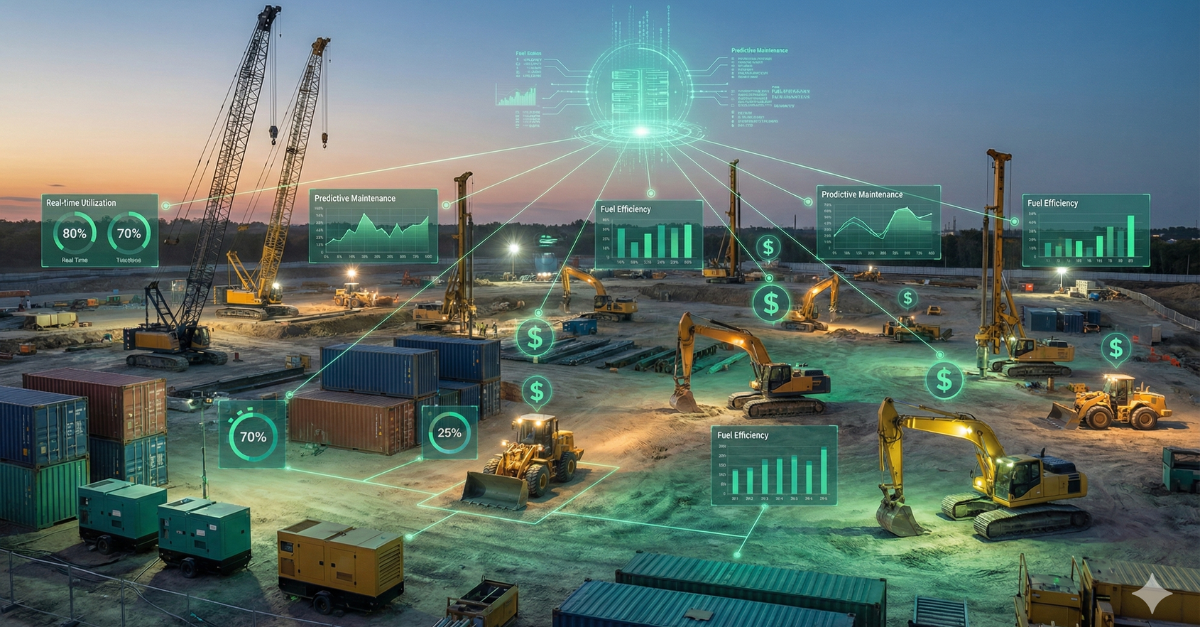
When you analyze six months of asset tracking data rather than six minutes of real-time monitoring, you often discover that your shortage is actually an efficiency problem. You might find that while your skid steers are “deployed” to job sites 100% of the time, their actual utilization is only hitting 20%. They are sitting idle. They are parked behind a fence. They are hoarding capital that could be deployed elsewhere.
This is the utilization mirage. It looks like you are at capacity. In reality, you are bloated.
By auditing long-term usage patterns, businesses can make hard-hitting decisions about right-sizing their inventory. You might realize you can sell 10% of your assets without impacting operations. This instantly injects cash back into the business. Alternatively, you might identify that three smaller projects can share one piece of specialized equipment if the schedule is optimized based on historical usage peaks. This prevents unnecessary procurement. It forces your operations team to be disciplined rather than reactive.
Transforming Procurement into a Science
Most companies buy equipment based on relationships, sticker price, or gut feeling. They stick with a specific manufacturer because the sales rep buys good lunches or because “that’s what we have always used.”
This approach is obsolete.
Your asset tracking data acts as an unbiased review of every piece of hardware you own. If you look at the lifecycle metrics over a three-year period, the truth surfaces. You can compare the maintenance intervals of Brand A versus Brand B. You can see which assets consistently require more downtime repairs. You can identify which generators consume more fuel for the exact same output.
This intelligence transforms procurement from a purchasing function into a strategic advantage.
When you walk into a negotiation with a supplier, you are no longer arguing about the sticker price. You are arguing about the total cost of ownership. You have terabytes of proof to back you up. You can demand better warranty terms for components that your data shows are prone to failure. You can shift your entire buying strategy away from the lowest upfront cost to the lowest long-term operational cost.
Furthermore, this intelligence dictates the optimal moment to divest. Every asset has a specific “sweet spot.” This is where its resale value is high, but its maintenance costs are about to spike. Historical maintenance data allows you to predict that cliff before you drive over it. You can cycle assets out of your inventory at the precise moment required to maximize recovery value. This is far superior to driving them into the ground and selling them for scrap.
Forecasting and Workforce Planning
Operational bottlenecks rarely happen without warning. They are usually the result of seasonal trends that repeat themselves year after year. Yet businesses continue to act surprised when they occur.
Long-term asset tracking data serves as a crystal ball. By layering asset activity over your calendar, you can see the pulse of your business. You might identify that every October, your usage of heating equipment spikes by 30% while your excavation machinery usage dips.
This insight helps with more than just equipment. It helps with people.
If you know your asset utilization peaks in Q3, you know your maintenance burden will peak in Q4 as that equipment comes off the line. You can staff your service department accordingly. You can pre-order the specific parts that statistically fail after high-intensity usage periods. You move from a reactive posture to a proactive one. You are prepared for the inevitable.
This level of forecasting allows for smarter bidding on contracts. If your data shows that your current inventory is only at 60% effective utilization during the winter months, you can aggressively bid on winter projects with a lower overhead calculation. You know you do not need to lease additional equipment. You can use your idle capacity to undercut competitors who do not have a grip on their true operational costs.
New Business Models and Revenue Streams
Perhaps the most exciting application of long-term data is the ability to change how you make money.
Traditionally, equipment rental companies charge by the day or the week. It is a clumsy metric. A customer who runs a compressor for 24 hours straight pays the same “daily rate” as a customer who runs it for two hours. The heavy user burns through the asset’s lifecycle value much faster. Meanwhile, the light user feels they are overpaying.
Granular usage data allows for “Power by the Hour” business models.
You can transition from renting equipment to selling capacity. You can bill customers based on exact run-times or even the intensity of the load. This aligns the cost perfectly with value for the customer. It also ensures you are compensated for the actual wear and tear on your machine.
For service companies, this data opens the door to performance-based contracts. Instead of charging a flat monthly fee for facility management, you can offer a contract based on guaranteed uptime. You use your condition monitoring data (vibration, temperature, humidity) to predict failures and intervene before they happen. You are no longer selling a repair crew. You are selling the assurance that the machine will never stop running. This creates a stickier relationship that competitors without deep data integration cannot match.
Overcoming the Data Silo
The biggest barrier to this strategy is not technology. It is culture.
In many organizations, the maintenance team looks at repair logs. The finance team looks at depreciation schedules. The operations team looks at the daily location map. These three groups rarely share their view of the truth.
Strategic asset tracking data breaks down these silos. It forces the finance team to understand that “cheap” equipment is costing more in repairs. It forces operations to understand that hoarding assets hurts the balance sheet. It creates a single source of truth for the entire organization.
Implementing this requires a shift in mindset. You must stop viewing tracking hardware as an insurance policy against theft. While theft recovery is a valuable feature, it is a reactive benefit. Business intelligence is a proactive benefit. One protects value you already have. The other creates new value.
The HoloTrak Advantage
This transition requires more than just hardware. It requires a platform built for intelligence.
At HoloTrak, we design our systems to capture the nuances that matter to business leaders. We do not just record that a piece of equipment is on a job site. We track the inputs that define value. We look at battery health to predict failure. We track door sensors to verify if a storage container is actually being accessed or just taking up space.
We understand that the location pin is just the beginning.
The competitive advantage of the future belongs to the companies that can read the invisible patterns in their operations. It belongs to the leaders who use asset tracking data to tighten their supply chains. It belongs to those who sharpen their procurement and innovate their business models.
The technology to do this is already here. The sensors are installed on your equipment. The satellites are orbiting above. The data is flowing into your servers. The only variable left is your willingness to look beyond the day-to-day.
Don’t just track your assets. Optimize them. Reshape your strategy around them. That is the power of true business intelligence.
Ready to Unlock Your Data?
If you are ready to move beyond simple location updates, it is time to talk. Contact HoloTrak today to see how our solutions can turn your asset data into your biggest competitive advantage.